

INTRODUCTION
When commercial growth feels harder than it should
Let’s start with something you probably already know.
The strategy is sound. The team is capable. The ambition is real. And still, growth does not quite behave the way it should. Some markets perform well. Others disappoint. One quarter beats the forecast. The next, you find yourself trying to make the numbers sound better than they are.
If you are responsible for revenue, whether your title is CEO, CCO, CRO or commercial director, this pattern will feel familiar. Not in a vague way. In a specific, slightly uncomfortable way.
At some point, most commercial leaders land on the same question: is this a people problem, a strategy problem, or something else entirely? The honest answer, in most cases, is something else entirely.
| 28% of executives and managers responsible for strategy execution can name three of their organisation’s strategic priorities. MIT Sloan Management Review | 63% is the average share of the financial performance organisations deliver against what their strategy promises. Marakon & Mankins, HBR |
SECTION ONE
It’s rarely a people problem
When commercial performance is uneven, the natural place to look is the people. That makes sense: results are delivered by people, so the questions follow: do we have the right individuals? Do they have the right skills? Are they managed well enough? These aren’t wrong questions. They’re just incomplete.
Across more than 25 years of working with commercial organisations, one pattern repeats regardless of industry, size or geography: capable people, dropped into a poorly designed commercial system, will consistently underperform. Not because they lack ability or effort, but because the system around them doesn’t support consistent results.
| WHAT WE’VE SEEN A technology company spent three years replacing its commercial leadership. Each new hire was stronger than the last, with sharper instincts, more energy and a genuine mandate to change things. Each one, within eighteen months, was producing results that looked remarkably similar to their predecessor’s. The organisation concluded, each time, that the fit hadn’t been right. It never concluded that the system the new leaders walked into hadn’t been built to support them. |
| “The organisations that grow well are not simply the ones with the best salespeople. They are the ones that have built a commercial engine that lets good people perform at their best, consistently.” |
SECTION TWO
The illusion of progress
Organisations under commercial pressure become more active, not less. New initiatives are commissioned. CRM systems are configured. Training is delivered. Each effort is justified. Each produces a genuine, if temporary, sense of momentum. The problem is that they rarely add up.
| WHAT WE’VE SEEN A B2B technology company had, over three years, introduced a new sales methodology, replaced its CRM, restructured its commercial team and invested significantly in management development. Each programme was carefully designed. Yet the commercial director could not point to a material improvement in pipeline quality, conversion rates or forecast accuracy. Each initiative had been built in isolation, optimising for different outcomes. Individually, each made sense. Together, they were working against each other. |
This is the pattern we call the illusion of progress. From a distance, the organisation is clearly investing in growth. Up close, the investment is fragmented. Activity increases. Complexity increases. The commercial engine does not become more effective.
| “The question is not whether enough is being done. In most organisations, the answer to that is clearly yes. The question is whether what is being done is connected.” |
SECTION THREE
What actually drives commercial performance
Where growth is strong and repeatable, three things tend to be true. People understand clearly what the organisation is trying to achieve. The commercial processes and systems in place actively guide their work, rather than document it after the fact. And leadership behaviours reinforce the right priorities, consistently, week after week.
Where performance is inconsistent, it’s rarely because the strategy is wrong or the people are poor. More often, something is broken in the connections between these things.
Two organisations with the same headcount, the same market and the same strategy can produce materially different results, not because one is working harder, but because one is working more coherently. That yield gap is where the real commercial opportunity lives. It does not require finding better people. It requires connecting the ones they have.
| “The problem is almost never that one part is broken beyond repair. The problem is that the parts are not sufficiently connected to each other.” |
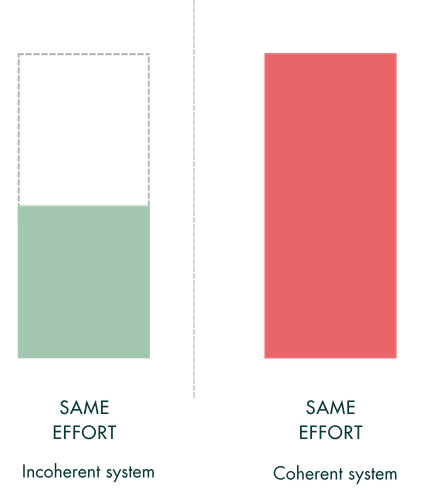
Same headcount. Same market. Same strategy. The difference in output is the yield gap, and it’s where the real commercial opportunity lives.
SECTION FOUR
A more useful way to look at commercial growth
Most organisations already have what they think they need: a strategy, a CRM, a sales team working hard. The challenge is almost never the absence of these elements. It is the gap between having them and having them work together.
A more useful way to understand commercial growth is as three connected disciplines: not workstreams, not phases of a programme, but ongoing practices that must be developed together, because each creates the conditions the next one depends on.
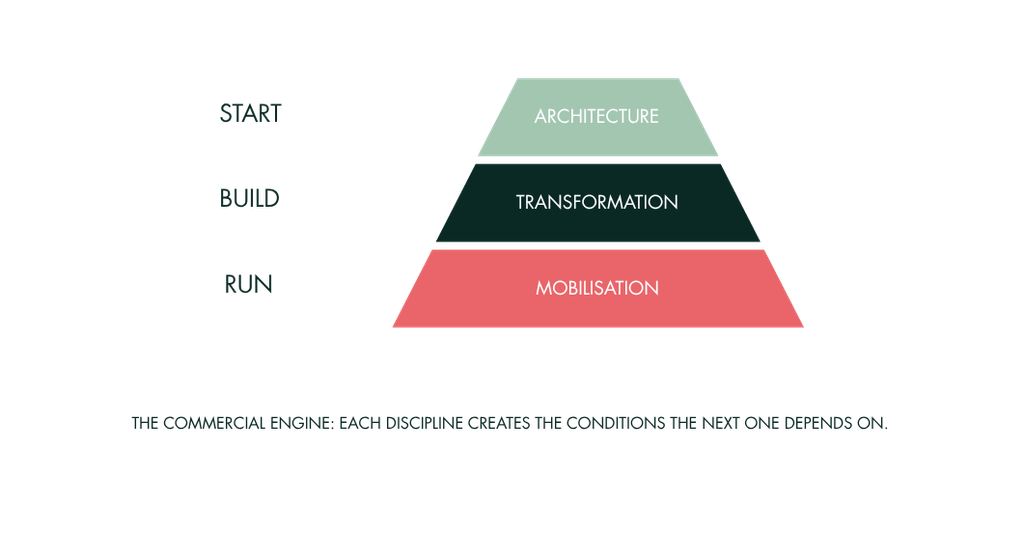
Where is your commercial system disconnected?
That is the question we start with in every conversation: not which initiative to launch next, but which of the three disciplines needs attention, and where the connections between them are missing.
Most organisations don’t need to start again. They need to build and connect the piece that’s missing.
| LET’S TALK ABOUT YOUR COMMERCIAL ENGINE |