Picture a bus labelled Strategy. Inside, most of the passengers are crammed into the first three rows: the consultants, the strategy team, the senior leaders who designed the direction. The back of the bus, where the people who will actually execute the strategy are sitting, is largely empty. The bus is front heavy and barely moving.
This is not a talent problem. It is a translation problem. The strategy was built in the front of the bus. It never reached the back. And until it does, until the people who are expected to execute it understand not just the direction but the specific choices it requires, the strategy exists as a document rather than a direction.
Most strategies are not wrong. They are insufficient. They describe the market reasonably. They articulate a competitive position with reasonable plausibility. They set growth targets that are ambitious without being implausible. And they fail to produce the commercial results they promise, not because the analysis was wrong, but because the strategy was not built with the precision required to guide the organisation through the hundreds of choices it will make in the months that follow.
| 63% of the financial performance organisations’ strategies promise is what they deliver on average. Marakon & Mankins, HBR | 28% of executives and managers responsible for strategy execution can name three of their organisation’s strategic priorities. MIT Sloan Management Review |
STRATEGY IS THE ART OF CONSTRAINTS
Everything in commercial life is constrained. Time is limited. Capital is limited. Management attention is limited. These constraints are not problems to be solved. They are the conditions within which strategy is made.
Strategy, properly understood, is the art of working within those constraints to maximum effect. It is not about finding more resources or being everything to everyone. It is about making the choices that concentrate available resources on the opportunities where the organisation has the greatest right and ability to win. That requires the willingness to accept that saying yes to these customers means saying no to those ones.
An organisation that cannot say no does not have a strategy. It has a list of things it is trying to do, which is not the same thing.
WHERE TO PLAY, HOW TO WIN
The first strategic question is market choice: which customers, which segments, which geographies? Most organisations define their market too broadly, and broad market definition is not strategic neutrality. It is a choice, and its consequence is that the organisation spreads its resources too thin to build a genuine competitive position anywhere.
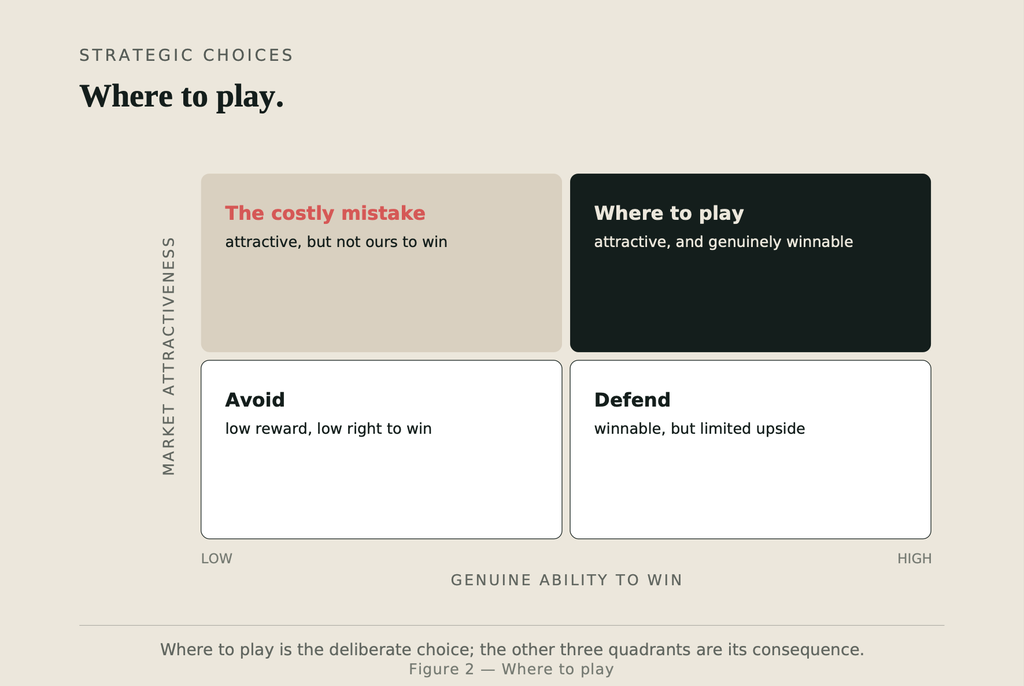
| WHAT WE’VE SEEN A professional services firm we worked with plotted roughly one hundred companies in its most relevant segments on a simple matrix: how attractive, and how likely to win. Twelve companies, out of the hundred, were where the combination of attractiveness and winnability was strong enough to justify genuine strategic investment. Not twelve companies they were currently prioritising. Twelve companies they should actually be focused on. Within eighteen months, the win rate in the priority segment had risen materially, not because the team worked harder, but because they arrived at those twelve customers with a depth of preparation that distinguished them from competitors spreading their attention more broadly. |
Once the market choice is made, the second question is differentiation: why should these customers select this organisation over the alternatives? The practice of how to win requires an honest view of what the organisation is actually better at than its competition, stated specifically enough to be useful rather than merely flattering. If the answer to why a customer chose you is vague, the value proposition is vague. If it is specific, it is doing real work.
THE FOUR TESTS OF A STRATEGY THAT CAN BE BUILT FROM
The difference between a strategy document and a well crafted strategy is a question of four things: the quality of its choices, the genuineness of its competitive advantage, the coherence of its commercial logic, and the internal consistency of its elements.
The practical test of choice quality is simple: can the leadership team name three things the organisation is not doing because of this strategy? If the answer requires a long pause, the choices have not been made clearly enough. Choice quality also has to hold under pressure. The most common moment of strategic collapse is not the strategy review. It is the quarter when revenue is under target and the sales team begins pursuing customers outside the agreed priority segments because they move faster.
| “Strategy is made in the boardroom. It becomes real in the operating model, or it does not become real at all.” |
Coherence failures take several forms, and the most damaging ones rarely announce themselves. The segment choice and the go to market model can be misaligned: the strategy targets enterprise accounts, and the sales structure is still built for transactional volume. Each of these is individually manageable. Together, they are why an organisation can do everything reasonably well and still underperform its own ambition.
MUST WIN BATTLES
Strategy is not a list of things that matter. It is a choice about which fights to win. The concept of Must Win Battles, developed by Killing, Malnight and Keys, is precise: three to five battles the organisation must win to reach its most important goals. Not a portfolio of improvement areas. The few market facing contests that are decisive.
A genuine Must Win Battle faces the market, not internal process. It is concrete and measurable. And it needs an explicit must stop list, or it is just another initiative added to an already full agenda. BCG’s analysis of transformation programmes found that organisations can typically realise 80 percent of transformation value by focusing on approximately 20 percent of their initiatives.
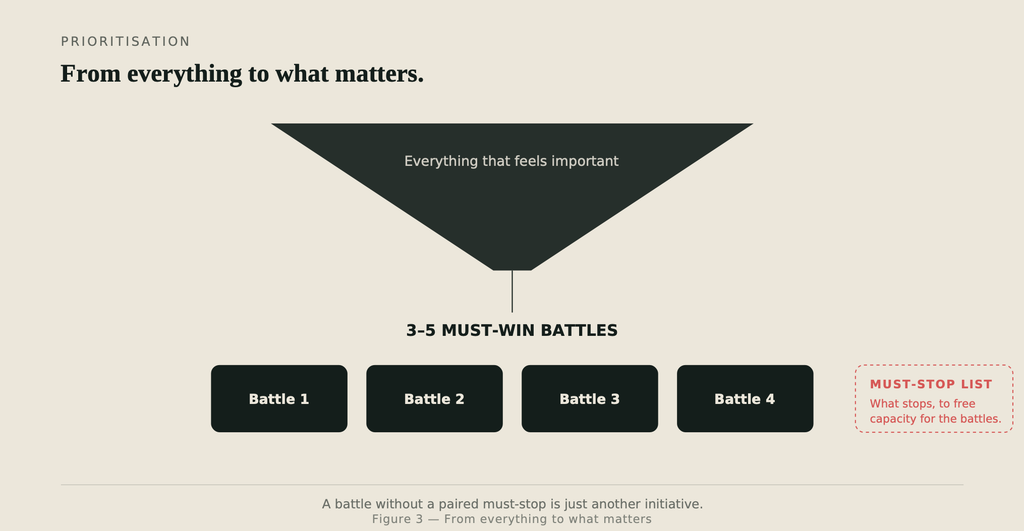
| WHAT WE’VE SEEN We worked with an international gaming accessories company active across multiple product categories, three sales channels and a range of European markets. Every product was important. Every market had potential. The result was that none of them received enough force to move anything decisively. The leadership team selected one overarching battle: winning the affordable performance gaming category position with selected retailers across Europe, with three supporting battles beneath it, each paired with an explicit must stop. The strategy had become usable, not because the slides improved, but because the fights had been chosen. |
A Must Win Battle only becomes real when it changes the commercial operating system: pipeline priorities, account plans, resource allocation, incentive structures. If none of these change, the battle has been presented, not implemented. The most practical test: if a salesperson cannot explain how this week’s work contributes to a Must Win Battle, the battle has not landed.
WHAT TO DO ON MONDAY
Translating strategy into daily behaviour requires three actions most organisations skip. First, a must stop conversation, specific enough that a sales manager can use it to decline a request. Second, reconfiguring the pipeline review to ask how each opportunity connects to the chosen battles. Third, reallocating the best people, because nothing communicates strategic priority more clearly than where the strongest commercial talent is deployed.
None of these require a new programme or a big relaunch. Organisations that simply make the must stop list explicit typically see the shift in daily behaviour within a single quarter.
A strategy that is visible in the daily decisions of the commercial organisation is a strategy that is working. It has made it from the boardroom to the back of the bus.
The organisations whose commercial results compound year on year are rarely the ones with the most sophisticated strategy documents. They are the ones willing to have the harder conversation: which three to five fights actually matter, what will be stopped to make room for them, and whether the choices made in the boardroom are still visible in the pipeline review three months later, when the pressure to expand back to everything inevitably arrives.
| WHERE THIS LEADS Which three to five fights are you actually fighting? That is the question we start with in every strategy conversation, not whether the ambition is right, but whether it has been translated into choices specific enough for a salesperson to act on this week. If you would like to test your own strategy against the four tests in this paper, we would be glad to talk it through with you. LET’S TALK ABOUT YOUR MUST WIN BATTLES |