

Everyone Has One Incentive System. Most Have Two.
Show me the incentive, and I will show you the outcome. Charlie Munger’s statement is almost uncomfortably direct. What makes it useful is not its cynicism. It is its precision. People do not generally behave irrationally. They respond, with remarkable consistency, to the signals the system around them is sending.
Every commercial organisation has an incentive architecture. Very few of them designed it. The formal system, the bonus scheme, the commission structure, the KPIs on the dashboard, was built deliberately, at some point, by someone. But around it, over years of accumulated decisions, recognition rituals and management habits, a second system grew. Less visible. Never documented. Never reviewed. And in most organisations, considerably more powerful than the one that appears in the HR policy.
That gap is where most commercial transformation programmes quietly die.
WHAT THE INFORMAL SYSTEM ACTUALLY REWARDS
Consider a sales organisation that has just run a company wide initiative on cross functional collaboration. Leaders have communicated the message. Workshops have been held. Collaboration is in the values.
Then, in a team meeting on a Tuesday morning, one rep is called out enthusiastically, publicly, for single handedly landing a major new client. A real winner, the manager says. What does everyone else in that room conclude? Not that collaboration doesn’t matter. They conclude that what actually matters, what you need to do to be seen and valued, is to land deals on your own. The informal reward system has spoken. No policy document was required.
This dynamic plays out in predictable variations. A company launches a new product line and wonders why adoption is slow: the bonus structure still rewards the old portfolio, which is easier to sell and pays out faster. In each case, people are doing exactly what the system rewards. The problem is not the people. It is the architecture.
THREE LAYERS, ONE ARCHITECTURE
Most commercial leaders think about incentives in terms of financial rewards: salaries, bonuses, commissions. These matter, but they are one layer of a three layer system.
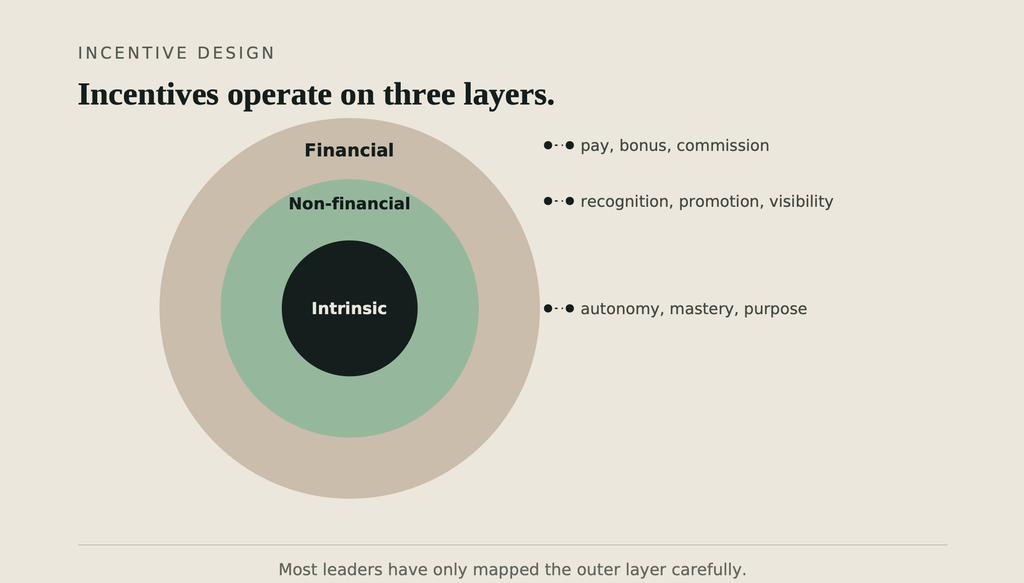
The second layer is non financial: recognition, promotion, status, access to high profile clients. A rep promoted after three years of diligent account management, and a rep promoted after landing two significant new clients, are receiving very different information about what the organisation actually values.
The third layer is intrinsic: the degree to which the work itself generates motivation through autonomy, mastery and purpose. This is the layer most senior leaders mention last and think about least. It is also the layer that determines whether people go through the motions or genuinely commit.
There is a further complication. Every metric you measure and make visible already functions as an incentive, whether you intended it that way or not. The moment a number appears on a dashboard that a manager reviews every Monday morning, it becomes a behavioural signal.
| WHAT WE’VE SEEN A professional services firm had built its talent model around a classic partnership structure: consistent performance over time leads to increasing responsibility, and ultimately to partnership. The model had worked for decades. Then, gradually, it didn’t. Younger professionals were leaving earlier and earlier. Exit interviews pointed to the same theme: the reward at the end of the path was not compelling enough to justify what the path required. If a firm’s best young talent is leaving and nobody has looked at the incentive architecture as a possible cause, that is itself a misalignment. It may not be visible yet. It is already shaping behaviour. |
NECESSARY, NOT SUFFICIENT
One of the most common mistakes in sales leadership is the assumption that if you get the incentive right, the behaviour will follow. It is only partially correct. For a behaviour to occur consistently, three conditions need to be in place simultaneously: capability, the knowledge and skill to perform it; opportunity, the processes and tools that make it practically possible; and motivation, where incentives operate.
A sales leadership team wants reps to invest more time in cross selling to existing accounts. They introduce a KPI and attach a bonus to it. Six months later, activity has barely moved. The incentive was well designed. But the reps lacked product knowledge across the portfolio, and the CRM made it genuinely difficult to identify cross sell opportunities. The motivation was there. The capability and the opportunity were not.
| “Show me the outcome you are not getting, and there is usually an incentive somewhere working against it.” |
THE LEADER WHO IS EXEMPT
The gap between what an organisation understands and what it does is not primarily a knowledge problem. It is a behaviour problem, and behaviour is shaped almost entirely by what leadership pays attention to, asks about and tolerates, not by what is written in the strategy document.
The most reliable indicator of whether a commercial transformation will take hold is whether the leaders whose behaviour shapes the organisation’s culture have changed what they do. The programme runs, the training is delivered, and then it fades from the hallways because the most senior person in the room never changed their own behaviour. They approved the initiative. They attended the launch. That is not the same thing.
This does not require a leader to become a different kind of person. It requires changing a small number of specific, repeatable habits: the questions asked in a pipeline review, the moments singled out for recognition. Those are within any leader’s control starting Monday.
DESIGNING FROM STRATEGY, NOT FROM HISTORY
The starting point for any genuine review is the strategy, not the bonus scheme. List the three or four behaviours the commercial strategy most depends on, and ask, honestly, what the current incentive system rewards. In most organisations, the answer reveals at least one significant misalignment.
A manager who says I know I should be coaching my team, but my time is better spent finding new leads, that’s what I’m held accountable for, is not describing a coaching problem. They are describing an incentive problem. Redesigning the architecture is not a compensation project. It is a commercial strategy project, and closing the gaps rarely requires redesigning the entire structure. It requires making the three or four most consequential changes, and holding them against the priorities the leadership team has agreed matter most.
What is your second incentive system rewarding?
That is the question we start with in every incentive conversation, not what the bonus scheme says, but what your best people have quietly learned gets them noticed here.
If you would like an outside view of what your own architecture is actually rewarding, we would be glad to talk it through.