When the same three salespeople consistently carry the budget, win the largest deals, and get customers unstuck when others cannot, it is tempting to credit their talent. Talent is part of the explanation. But talent alone does not explain why the other twelve salespeople, with similar training and the same tools, produce results that are consistently lower, less predictable and harder to sustain.
Most commercial organisations do not have an engine. They have star performers. The distinction matters more than it first appears. The more productive question is not who is performing well. It is whether the organisation knows why they are performing well, and whether it has built that knowledge into how everyone works.
A Sales Engine is the capability that answers that question. It is the combination of sales process, tools and internal orchestration that ensures the right thing happens at the right moment in the customer’s decision journey, so that growing revenue does not depend on a handful of star salespeople.
THE PLAYBOOK IN THEIR HEAD
A Sales Playbook describes what good looks like. A Sales Engine makes good repeatable. The distinction is important because most organisations have the former and assume they have the latter. The playbook is documented. And yet, when a difficult enterprise deal needs to advance, the commercial leader still finds themselves reaching for the same two people who always figure it out.
The best salesperson in most organisations already has their own engine. It lives in their head. They know when the customer needs a business case versus when they need a reference. They are working from a mental model of how their best customers move toward decisions, one built through years of experience.
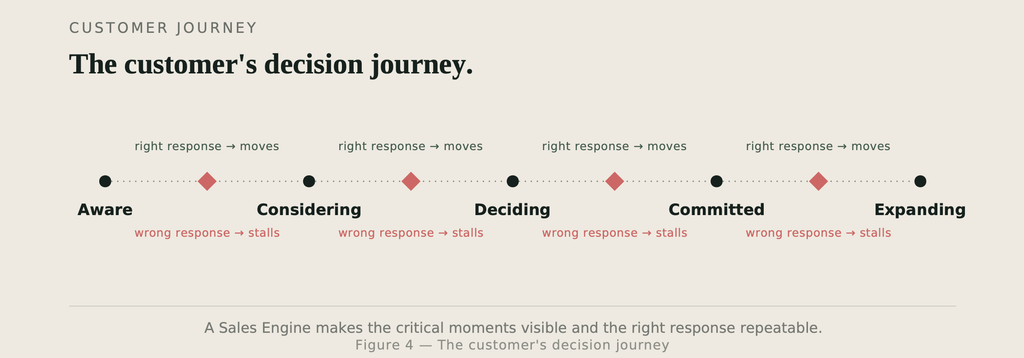
The job of a Sales Engine is to make that mental model organisational. Not to make all salespeople identical, that is a different and less interesting goal, but to make the key inflection points in the customer’s decision journey visible, supported and manageable for everyone.
WHAT THE CUSTOMER ACTUALLY DOES
The starting point for building a Sales Engine is not the internal sales process. It is the customer’s decision journey. Gartner’s research on B2B buying behaviour makes a point that should be uncomfortable for any organisation that has organised its pipeline around internal stage definitions: buyers do not move through a linear process designed for the seller’s convenience.
| 61% of B2B buyers prefer a buying experience that does not require direct contact with a seller. Gartner | 73% actively avoid suppliers whose outreach they find irrelevant. Gartner |
This does not make the salesperson unnecessary. It makes the salesperson’s relevance, timing and organisational support critical. A Sales Engine is built around the moments that matter in that journey: establishing that the problem is real, identifying a credible internal owner, building the economic case, addressing the risks that IT, legal or procurement will raise, and securing executive alignment. Each of these moments requires something different from the selling organisation. A Sales Engine ensures that what is required is ready before the customer starts asking for it.
BUILDING FROM THE BEST
The most reliable foundation for a Sales Engine is the behaviour of the organisation’s best salespeople. Not because best practice should be mechanically replicated, but because their intuitions usually contain genuine insight about how the customer moves.
What do the best salespeople do that the others do not? Where do customers typically stall, and what do the best do differently at those moments? The goal is not to replace the top performer’s judgement with a process. It is to make the insight that currently lives in their head available to the rest of the organisation.
ORCHESTRATING THE WHOLE ORGANISATION
A Sales Engine only works when the whole commercial organisation is connected to it. Marketing needs to be relevant to the specific moments where the customer is asking specific questions. Product specialists need to be available at the point where technical questions are being asked, not after the concern has hardened into an objection. Customer success needs to be visible before the contract is signed.
BCG’s research on B2B sales confirms that organisations which integrate marketing, sales and service across the full customer journey see materially stronger commercial results. This orchestration is where most Sales Engine efforts quietly stall. It requires marketing, product, customer success and sales to share a single view of where each customer actually is, not four separate views maintained in four separate systems.
| WHAT WE’VE SEEN We worked with a Nordic enterprise SaaS company selling a business critical platform to large organisations. On the surface, the organisation looked mature. Under the surface, the same three salespeople carried the largest quotas and advanced customers when others stalled. The diagnosis was not a lack of sales talent. It was that the organisation had mistaken individual strong salespeople for an organisational capability. The intervention documented what the top performers actually did at the critical moments and built those responses into the commercial operating model. Deal reviews changed character: the questions became about economic owner, internal alignment, risk addressed and executive buy in, the same questions the top performers had always asked themselves. |
| “The best commercial organisations are not the ones whose top performers are exceptional. They are the ones whose top performers’ knowledge of the customer is no longer only in their heads.” |
THE COCKPIT, NOT THE REPORT
A working Sales Engine gives leadership a view of what is actually happening in the customer’s journey, not just what is happening in the CRM. A report tells the commercial leader how many opportunities are in each stage. A cockpit tells them where customers are stalling and why, and what the organisation is learning from the deals it is losing.
McKinsey’s research on data driven commercial growth engines found that organisations which use commercial data to drive priorities and feed learning back into the system achieve above market growth and EBITDA improvements of 15 to 25 percent over time. That figure is not an argument for more dashboards. It is an argument for building a commercial system that actually learns.
An organisation can have an excellent strategy and a strong sales team and still consistently underperform commercially, if the engine that connects them has not been built. That shift rarely requires new technology or a larger sales team. It requires the discipline to ask, honestly, what the best people in the room already know that nobody has written down, and the patience to build that knowledge into the system before the person carrying it walks out the door.
| WHERE THIS LEADS Is it a motor, or a miracle? That is the question we start with in every Sales Engine conversation: what happens to your growth the day your best two people are unavailable, and what would it take to make sure the answer is not very much changes. If you would like to talk through what a Sales Engine could look like for your organisation, we would be glad to help. |